
For years the website has been regarded as the central “destination” of the internet. People searched on Google, visited a website, read the content, compared several sources and only then made a decision.
The growth of generative AI, however, is changing that journey quickly.
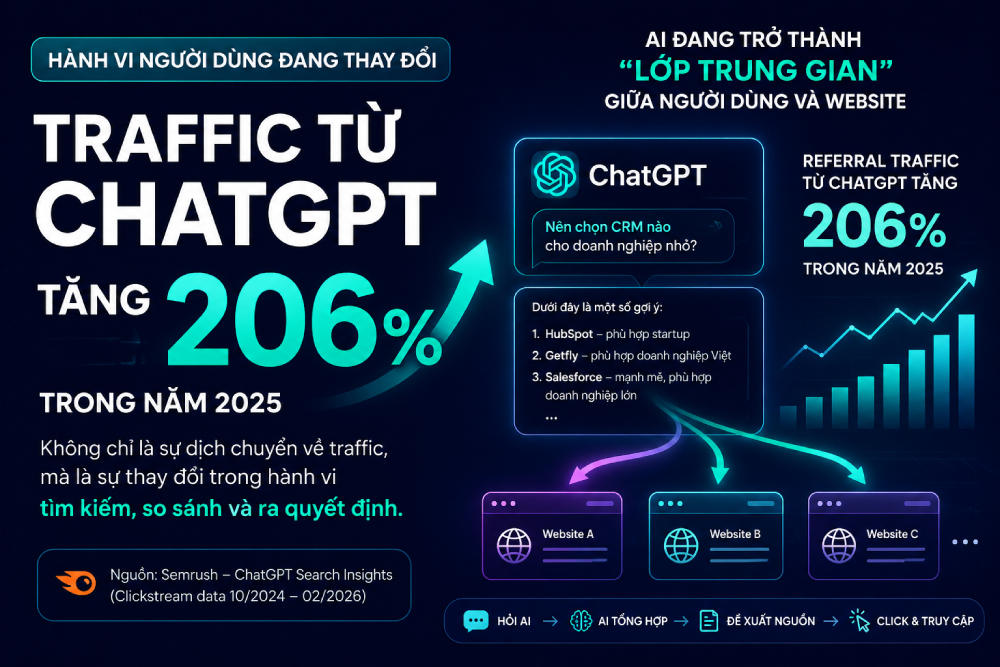
According to Semrush’s latest clickstream research, referral traffic from ChatGPT to websites rose 206% during 2025. That figure reflects more than a rise in traffic: it points to a major shift in how people reach information and make decisions online.
AI is gradually becoming a new “intermediary layer” between the user and the internet.
From search engine to answer engine
In the traditional search model, the search engine acts as a navigation tool. The user enters a keyword, the system returns a list of links and the user does the analysis themselves.
The common journey used to be:
Google → open several tabs → read → compare → keep searching → decide.
But with platforms such as ChatGPT, Gemini, Claude and Perplexity, this behaviour is shifting towards something more conversational and more direct.
People are starting to ask questions with specific context:
- “Which CRM suits a small business?”
- “Should I use Shopify or Haravan?”
- “Roughly how much does deploying an AI chatbot cost?”
- “Should I outsource or build an in-house team?”
Instead of returning a list of search results, the AI will:
- synthesise the information
- analyse the pros and cons
- propose a solution
- make a recommendation suited to the context
What is notable is that people now no longer need to read as many websites as before. They tend to ask the AI first, push back over a few turns to verify the information and only visit a website when they need to go deeper or are preparing to decide.
The search engine is gradually becoming an answer engine.
AI does not create data of its own
One common misconception today is that AI “knows everything”.
In reality, AI systems do not create knowledge out of nothing. They synthesise and learn from an enormous volume of data on the internet, including:
- company websites
- industry blogs
- the press
- forums
- social media
- public documents
- structured data
This leads to a very important change in digital marketing:
Businesses are not only competing for rankings on Google Search but competing to be a data source the AI judges trustworthy.
In the era of AI search, being “cited”, “referenced” or “recommended” by AI may matter just as much as ranking for a keyword.
SEO is shifting into GEO
The growth of AI search has also brought a new concept: GEO (generative engine optimisation).
Where traditional SEO focuses on optimising a website to appear in a search engine, GEO aims at optimising so that AI can:
- read and understand the content
- establish the context
- assess how trustworthy it is
- synthesise the information
- use it as a reference source within an answer
This is no longer a game of “keyword stuffing” or producing content in bulk.
Modern AI systems weigh heavily:
- semantic relevance
- topical authority
- entity recognition
- structured data
- how deep the content goes
- brand credibility across multiple platforms
That also explains why many websites with a great deal of content are still rarely recommended by AI, while brands with a high-quality, in-depth content ecosystem appear regularly in AI answers.
The website is not disappearing, but its role is changing
The growth of AI search has led many to believe the website will lose its central role. In practice the opposite is happening.
AI still needs websites as the original data source from which to synthesise information.
The difference lies here:
The website no longer serves only the end user but must also serve what AI can read and understand.
That changes the standard for building a website in this new phase considerably. A modern platform needs more than an attractive interface or basic SEO; it also needs:
- a clear semantic architecture
- a good data structure
- fast loading
- efficient crawling and indexing
- in-depth content by topic
- schema markup
- logical internal linking
- the ability to integrate AI and automation
In the near future, the website will play the role of a “knowledge hub” — the place where AI draws data to serve the user’s decision journey.
A new competition for business
Businesses once competed for a position on the search results page.
Today the competition is shifting to another layer:
Who will become the source of information the AI trusts enough to put in its answer?
This is why modern digital strategies are beginning to focus more on:
- building topical authority
- developing in-depth content
- keeping brand data consistent
- optimising SEO and GEO in parallel
- deploying a website able to adapt to AI search
- integrating AI chatbots and semantic search into the user experience
Businesses that treat their website as a long-term data platform will have a clear advantage through this shift.
The era of AI search is only beginning
Referral traffic from ChatGPT rising more than 206% is only an early signal that user behaviour is changing far faster than previously forecast.
In a few years, the important question may no longer be:
“How do we get the website to the top of Google?”
but rather:
“How do we get AI to trust and choose our brand when it answers the user?”
As AI gradually becomes the intermediary layer between people and the internet, the ability to build a deep ecosystem of content, data and digital platforms will become a business’s long-term competitive advantage in this new era.
Reference:
- Semrush – ChatGPT Search Insights
