
For more than 20 years the internet has taught us an almost unconscious habit: if you want to know something, think of a keyword.
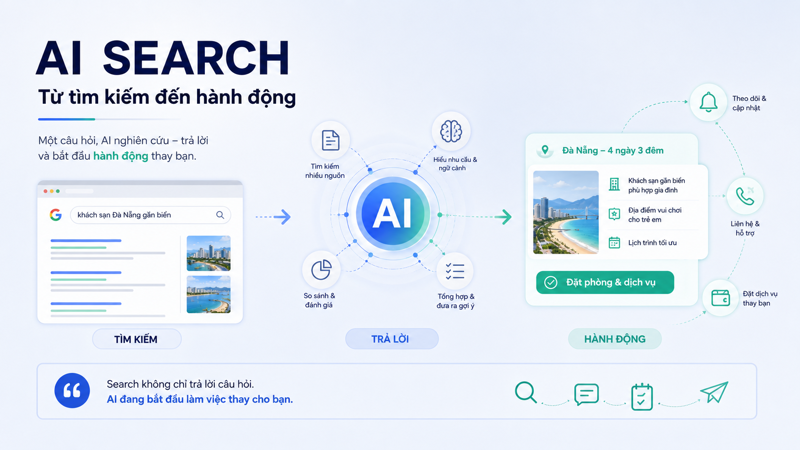
To travel to Da Nang we search “Da Nang hotel near the beach”, then “good places to eat in Da Nang”, “places for children to play”, “four-day Da Nang itinerary”. Then we open a stream of websites, read, compare and piece each fragment of information together into a complete plan ourselves.
AI search is changing that process.
Instead of splitting one need into a series of keywords for the search engine to understand, users are increasingly able to say straight out what they want:
“My family is two adults and two young children. We want to go to Da Nang for four days on a budget of about 20 million. Draw up an itinerary, find a hotel near the beach and suggest places suitable for children.”
This may look like nothing more than a change in how the question is asked. But behind it lies a far larger shift in the nature of search itself.
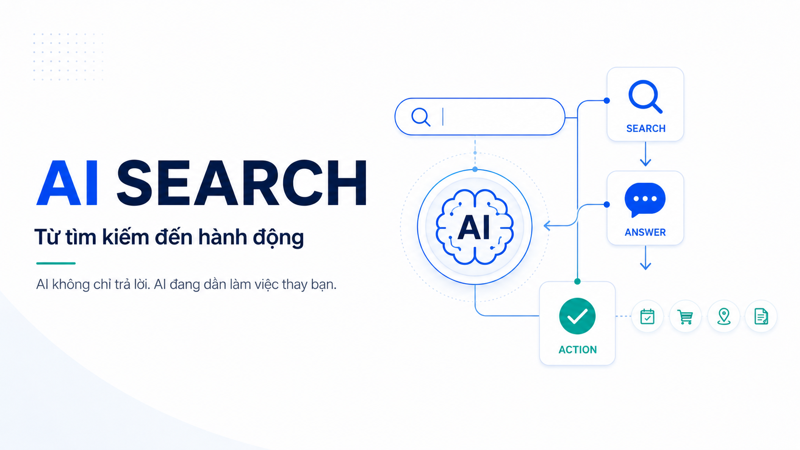
Search is moving from search engine → answer engine → action engine.
And when that process is complete, what the user needs may no longer be a list of websites to work through themselves. They will increasingly want to hand the whole job to AI.
The search box is changing
For many years the Google Search interface was virtually synonymous with a small box for typing a few keywords.
In May 2026 Google called its new Search design the biggest upgrade to the search box in more than 25 years. Instead of a short input field, the new Search is built so that users can describe a longer need, carry on a conversation and bring in many kinds of data such as text, images, files, video or a Chrome tab.
Usage data shows that user behaviour is moving in the same direction.
A year after AI Mode launched in the United States, Google says the feature has passed 1 billion monthly active users worldwide, while AI Mode queries have more than doubled each quarter since launch. More importantly, the average AI Mode query is now about three times as long as a traditional Google Search query.
Users are also no longer only “typing”. According to data Google published in May 2026, more than one in six searches in the United States uses voice or an image, while image searches are up more than 40% month on month.
These figures show that AI search is not simply Google placing an AI-written answer above the search results.
It is widening the very definition of what “searching” means.
Before, we had to work out which keyword Google needed.
In more and more cases, we need only describe what we actually want.
From search to research: one question can become hundreds of searches
The next change happens behind the interface, where the user barely sees it.
With traditional search, one query usually corresponds to one search. A user wanting to research more deeply has to change keywords, open more tabs, search again, read on and pull the information together themselves.
AI Mode uses a different approach that Google calls query fan-out.
Rather than treating the whole question as a single query, the system can break the problem into several smaller topics, run many searches in parallel, gather information from different sources and then synthesise it into an answer.
At a higher level, Deep Search takes this mechanism further still. Google says the system can run hundreds of searches, reason across many different sources of information and produce a cited report within a few minutes.
This creates a very notable change.
A request such as:
“I want to buy a laptop under 30 million dong for AI programming, with occasional video editing, prioritising good battery life and light enough to carry to work. Compare the suitable options.”
in essence contains a whole series of problems: working out the specification needed, finding products, reading specifications, checking prices, assessing performance, comparing weight, battery and user reviews, and finally ranking the options.
Previously the user had to carry out that chain of steps themselves.
In AI search, an ever larger part of the research process is handed over to AI.
This may also be why queries relating to planning are growing so fast. Google says that in the six months to May 2026, AI Mode queries related to planning grew about 80% faster than AI Mode’s overall growth. Brainstorming queries also grew about 30% faster than the overall rate.
Users are gradually realising that they need not ask AI a simple question.
They can hand AI a problem.
From research to action: AI begins to do the work rather than only answer
But search → research is perhaps still not the biggest change.
The next step is search → action.
At Google I/O on 19 May 2026, Google introduced a generation of Search Agents able to run continuously in the background. Users can create Information Agents to follow a topic while the agent scans websites, blogs, news and social media posts as well as real-time data on finance, shopping or sport.
For example, instead of hunting for a new flat every day, a user can describe their requirements in full and let the agent watch the market continuously. When a suitable flat appears, the system can notify them of its own accord.
That is no longer “I search”.
It is “keep searching for me until this condition is met.”
Google is also bringing agentic capability into tasks closer to transactions. Search can compile prices and availability for local services and take the user through to completing a booking; in some fields such as home repair, beauty or pet care, Google says users can ask the system to telephone the business on their behalf.
In earlier tests and products, AI Mode was also deployed for finding restaurant tables, event tickets and service appointments by searching several websites and booking platforms at once.
The boundaries are starting to become clear:
The search engine helps us find where the information is.
The answer engine reads the information and produces an answer.
The action engine understands the goal, researches the options and starts doing the work.
At that point the user’s question changes too.
From “What should I buy?” to “Find the best option for me.”
And eventually perhaps:
“If these conditions are met, buy it for me.”
E-commerce may be where the shift happens fastest
Shopping is one of the fields that shows the journey from search to action most clearly.
Also at Google I/O 2026, Google announced Universal Cart, a smart basket able to work across Search, Gemini, YouTube and later Gmail. Once a product is added to the basket, the system can keep running in the background to track discounts, price history or stock availability.
Universal Cart can also reason about the products in the basket itself. For example, if the user is building a computer themselves, the system can spot an incompatible component and suggest an alternative. Google is at the same time developing the Universal Commerce Protocol (UCP) as a common language for agents and commerce infrastructure, along with the Agent Payments Protocol for transactions carried out by agents within the limits the user sets.
Here an important change appears for business.
In the current e-commerce model, the website is designed mainly for people to read, compare and press the buy button.
In the agentic commerce model, another party begins to take part in the buying journey:
the customer’s AI agent.
The agent needs to know what the business sells, at what price, whether it is in stock, what the specifications are, what the returns policy is, where the shop is, which services still have availability and what the next step is to complete the transaction.
In other words, the website of the future may need more than to be “beautiful to people”.
It also has to be easy for a machine to understand.
Websites will have to serve both people and AI
This is where the AI search story starts to bear directly on a business’s digital strategy.
Over the past 20 years, a large part of SEO work has revolved around the question:
How do I get Google to find and rank my website?
In the era of AI search that question has not gone away. But new questions are appearing behind it:
Does AI understand accurately what the business provides?
Is the information on products, services, prices, locations, policies and company capability clear enough for a machine to cross-check?
When AI has to choose a source to answer a user, does the business give enough signals to be regarded as trustworthy?
And further still, when an AI agent wants to take an action — check a price, find availability, book, add to the basket or move to payment — can the business’s system support that action?
This is still a trend taking shape rather than a finished state of the internet. But the direction has begun to show fairly clearly in the way Google is building Search Agents, Universal Cart, UCP and the agentic booking features.
If the search engine once created the need for SEO, and the answer engine is now pushing businesses to care about GEO, AI search readiness and being citable, then the action engine may create a new layer of requirement: businesses must standardise not only their content but also their data and their system’s ability to interact.
A good article helps AI understand the business.
But an AI agent that wants to act will need more than a good article.
It needs accurate, structured, up-to-date data and a system capable of connecting to the outside world.
AI is not making search disappear. It is widening search
It would be easy to take the changes above to an extreme conclusion: that Google Search is dying or that websites will soon no longer be needed.
The current data does not show that.
Google says its AI features are making people search more, not less. In May 2026 the company said total Search queries had reached their highest level ever; by its Q2 2026 report, Google said again that AI Mode had passed a billion monthly users and that AI features were generating additional queries for Search.
What is changing is not the need to search for information.
What is changing is who does the work that sits between the need and the final result.
In the old model:
Person → Search → Website → Person researches → Person acts.
In the model now taking shape:
Person → AI → Internet → AI researches → AI recommends → AI helps act.
The website still exists in that value chain. But instead of always being the final destination of every search, the website can increasingly become the data source, the source of evidence and the transaction infrastructure that AI uses to complete a task for the user.
So the great challenge for business in the era of AI search is perhaps not to find a way to resist AI in order to preserve the internet behaviour of 20 years ago.
What matters more is preparing so that the business is still found, understood correctly and chosen when AI becomes the intermediary layer between the customer and the internet.
Over the past 20 years, businesses optimised their websites to be found by people on Google. Over the next 10 years, businesses may have to optimise their data, content and systems as well, so that AI finds them, understands them correctly, trusts them — and acts on behalf of the customer.
The future of search is therefore not simply Google having more AI-generated answers.
It is a deeper shift:
From finding information, to research.
From research, to deciding.
And from deciding, to handing the job to AI.
When that happens, search will no longer only be where we ask the internet what it has.
It can become the place where we tell the internet:
“This is what I need. Do it for me.”
