
Will the website become the “source of trust” in the AI era?
For years, businesses built websites with a fairly clear goal: to create somewhere to present products and services and attract customers from Google. But as people begin asking ChatGPT, Gemini and other AI tools instead of opening a string of websites themselves, that traditional role is changing considerably.
In future the website may no longer be the place a customer necessarily visits first. Yet there is a notable paradox here: the website may be visited directly less often, while becoming more important as the business’s official source of information.

When the internet is no longer short of information
The internet used to solve the problem of scarce information. Google helped us search among billions of pages to reach the most relevant content. But AI is moving the internet into a different state, in which producing and synthesising content is easier than ever.
In a matter of minutes, AI can produce an analysis, a product description, a review or even a complete website. As the volume of content keeps growing rapidly, the user’s problem is no longer simply “can I find the information?” but increasingly “which information can I actually trust?”
This is where the origin of the information becomes important.
Suppose a customer asks an AI about a business: what services does this company provide, what are the product specifications, what is the warranty policy, which projects has the business delivered. The AI can find information in many places — social media, the press, marketplaces, forums and other websites.
But if those sources give different information, which one reflects the truth most accurately?
In most cases, the business’s official website has the opportunity to become one of the most important sources for verifying that information.
From communications channel to official source of information
This is how I understand the idea of a “source of trust”.
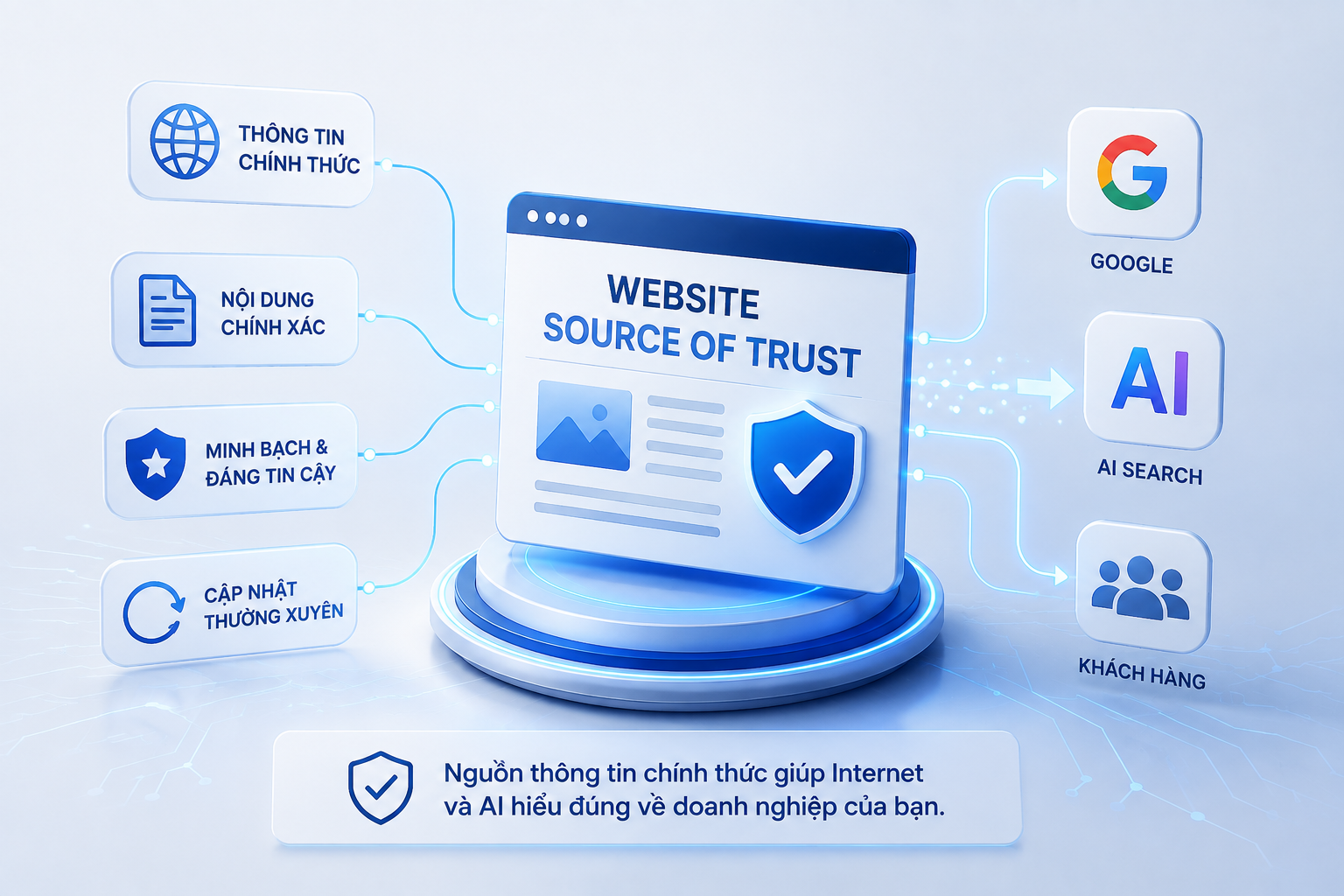
The website is not merely where a business states that it has product A or provides service B. It should become the place that holds the most complete, accurate and up-to-date version of the business itself.
Information on the brand, products, services, the team, projects delivered, sales and warranty policies, technical documentation and frequently asked questions can all be organised into an official body of knowledge.
This matters particularly in the AI era.
Where website content was previously built mainly for people to read and Google to index, in the years ahead a business must also allow for AI systems reading, analysing and trying to understand that information.
It is worth being clear-eyed, however: having a website does not mean the AI will automatically trust it. Credibility also comes from the quality of the content, the consistency of the information, evidence of capability, how up to date it is and whether that information is corroborated by other independent sources.
Put another way, a source of trust is not a website feature. It is credibility accumulated over time.
A website can hold value even without a click
This is perhaps the most interesting change.
In the traditional internet model, the value of a website was usually tied to traffic. The more visits it had, the more effective it was considered to be.
But in the world of AI search, part of a website’s value can appear even when the user never visits it directly.
A customer can ask an AI about the business, receive a synthesised answer and reach a decision without going through the traditional search journey. In that case what matters is not only whether the website is clicked but whether the business’s accurate information appears in the answer.
That means the way we assess a website’s value has to change too. Traffic and conversion remain very important, but alongside them a new question appears: how do the internet and AI systems understand our business?
Future websites need to be built differently
In my view, businesses will gradually have to shift from thinking of the “website as a place to post content” to the “website as the place that organises the official knowledge of the business”.
Products need clear, consistent information. Services need explaining in sufficient depth. Case studies need data and evidence. Specialist content needs to show who is responsible for the information. The questions customers regularly ask need an official answer. When a policy changes, the website should be among the first places updated.
Do that and the website serves more than the customers who visit directly. It also creates an information foundation from which Google, AI, partners, the press and other sources can understand the business more accurately.
In my view this will be one of the most important values a website holds in the years ahead.
The website may no longer be the starting point of every search journey as it once was. But as the internet enters a period of surplus AI-generated content, an official, trustworthy source of information becomes all the more valuable.
The website of the future therefore does not only need to be found.
It needs to become a source worth trusting and citing.
