
Whenever a major technology appears, the first question is often: how many jobs will disappear?
AI is no exception.
ChatGPT can write content. AI can program, analyze data, generate images, read contracts, respond to customers, or synthesize hundreds of pages of documents in a very short time. As these capabilities advance month by month, concern that AI will replace people is entirely understandable.
But perhaps we're asking the wrong question.
With AI, the more important question is not “which occupations will disappear?”, but rather:
“Within each current job, which tasks will be handed over to AI and which tasks will still require humans?”
Because AI does not necessarily need to replace an entire occupation to change the labor market.
It only needs to take over enough tasks – the small components that make up a job.
When tasks change enough, the role of the human performing them will also have to change.
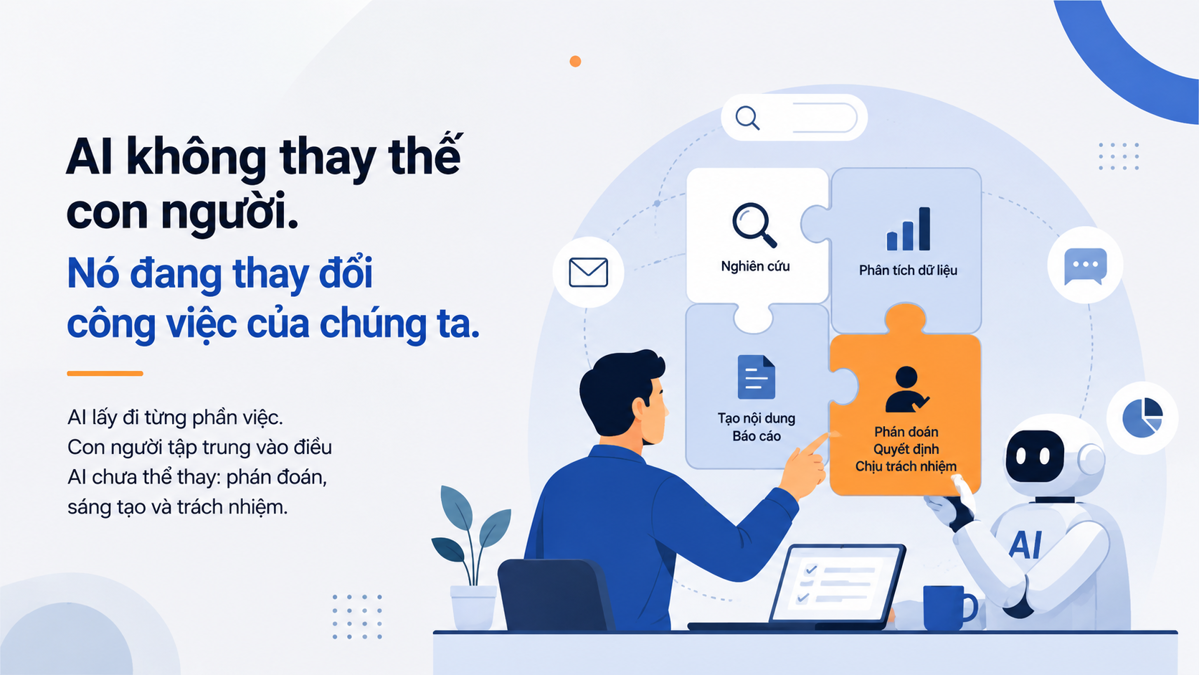
AI is replacing tasks before it replaces jobs
A marketing employee does more than just “do marketing.”
A day's work can include market research, topic discovery, competitor analysis, planning, content creation, editing, campaign monitoring, data aggregation, reporting, and recommendations.
A programmer does more than just “write code.” They must understand requirements, design solutions, implement, test, debug, review code, handle incidents and make technical choices that affect the whole system.
Similarly, a customer success representative does more than “reply to customers.” The job also involves identifying needs, looking up information, handling exceptional situations, spotting customers at risk of churn, coordinating with other teams, and deciding when to escalate issues.
AI doesn’t have to perform an entire value chain to create impact.
It only needs to handle initial research, create drafts, aggregate data, search documents, or process repetitive questions and structured parts of work that are starting to change.
This is also a key observation in research by the International Labour Organization.
In 2025, ILO estimated roughly a portion of the global workforce is working in occupations with a certain level of exposure to GenAI. However, the organization concluded that this does not clearly mean a share of jobs will disappear. On the contrary, because many occupations still require human involvement, ILO argues that task-level transitions are likely to be more common than full occupational replacement.
By April 2026, ILO published a separate study for Việt Nam and presented a more nuanced picture.
About 11.5 million workers in Việt Nam, roughly equivalent to a portion of the labor force, are employed in occupations where some tasks could be affected by GenAI. But only about one million people are in roles that combine tasks both easily handled by AI and highly standardized. That group accounts for under 2% of the labor force.
The gap between “20% potentially affected” and “under 2% at high risk of full automation” shows something important:
AI is first and foremost a story about reconfiguring task structures, not simply eliminating job titles.
When AI executes parts of the work, the value of human contribution shifts
Imagine an employee who used to spend three hours collecting data and two hours producing a report.
If AI reduces the data-collection portion to 30 minutes, the company will no longer primarily evaluate that employee by their ability to “produce a report.”
The new question becomes: what do you see in the numbers?
Which data look unusual?
Where does the problem originate?
Should the plan change?
What decisions need to be made?
Value is shifting from output production to problem understanding and decision-making about that output.
The same happens in marketing. AI can generate dozens of ad concepts in minutes, but humans still need to understand customers, position the brand, and pick which messages are worth allocating budget to.
In programming, AI can produce code faster, but production systems still need people who understand architecture, security, data, scalability, and the consequences of technical choices.
In customer care, AI agents can handle thousands of conversations, but businesses must design boundaries: what AI is allowed to advise, which information needs verification, when to hand off to a human, and who is accountable for decisions that have real-world effects.
Microsoft Work Trend Index 2026 shows this trend emerging among people using AI at work. In Microsoft’s survey, 66% of AI users say the technology helps them spend more time on higher-value work. When asked which capabilities become more important as AI takes on more tasks, the top choices are quality control of AI outputs and critical thinking. Notably, 86% report they view AI outputs as a starting point rather than final answers and still consider themselves ultimately responsible for outcomes.
That may signal how labor value is migrating.
When content, code, reports, or preliminary analyses become cheaper to produce, abilities that are hard to automate—such as scoping, goal-setting, contextual understanding, validation, creativity, and accountability—become more valuable.
From doers to coordinators
For many years, software was mainly a tool.
People opened Excel to calculate, CRM to manage customers, ERP to enter data, Photoshop to design.
AI agents create a different model.
Instead of only providing tools for humans to operate, systems can now accept an objective and execute parts of the work to achieve it.
A future employee might work alongside an AI that researches the market, another AI that compiles reports, an AI that processes data, and an AI that supports customers.
The role of the human and the leadership shifts from:
doing every operation themselves
to: defining objectives → assigning tasks → checking → adjusting → deciding
Microsoft calls part of this process “rearchitect work” – redesigning how work is carried out.
Work Trend Index 2026 argues the real challenge for businesses is no longer simply whether employees know how to use AI. The larger issue is systems, processes, culture, and how organizational performance is measured: are these redesigned to absorb AI capabilities or not. The study even records many cases where employees’ AI capabilities advanced faster than organizational change.
That explains why simply buying a ChatGPT account, Copilot, or a few AI agents is not automatically an AI transformation.
If processes remain unchanged, responsibilities unclear, data unstandardized, and humans still have to manually recreate AI outputs, the company has only introduced a new tool into an old way of working.
Bigger value appears when companies start by asking:
How should this work be redesigned if every person in the organization had an AI assistant?
“AI does not replace humans” does not mean every job is safe
Conversely, the phrase “AI does not replace humans” can create a false sense of security.
If a task that used to take four hours now takes 30 minutes, the demand for human labor to produce that output will almost certainly change.
Some roles will shrink. Some repetitive jobs will be strongly automated. Some teams may be smaller while still producing greater output than before.
World Economic Forum in Future of Jobs Report 2025 forecasts technological, economic, demographic, and green transitions could create around 170 million new roles by 2030, while displacing about 92 million current roles, a net change equivalent to about 78 million jobs. WEF also estimates nearly 40% of the skills needed for current work may change during this period.
These figures do not mean AI will directly create 170 million jobs or wipe out 92 million roles. AI is only one of many forces at play.
But they show long-term change is not only about the total number of jobs increasing or decreasing by a few million.
The core issue is the gap between the skills the market needs and the skills people currently have.
People who have historically been paid mainly to write content may now also need to understand strategy, verify information, and distribute content.
Programmers may spend less time typing code and more time understanding problems, designing systems, and reviewing AI-generated products.
Customer service staff may not need to answer hundreds of repetitive questions, but will focus on handling complex, sensitive, or high-value situations.
Managers will not just manage people. They must learn how to design work so that people and AI jointly produce outcomes.
Therefore, the real pressure may not come from some AI simply “taking your job.”
It can come more insidiously.
The work remains.
Job titles remain.
But the standards required to perform those jobs well change.
Companies should not start with the question “How many people will AI replace?”
This is one of the easiest approaches to make an AI project go wrong.
If the initial goal is “replace three employees with one AI,” the company risks automating a process that was never designed to be automated.
AI may make a poor process run faster, not automatically turn it into a good process.
A more reasonable starting point is to break work down into discrete tasks.
Which tasks are repetitive?
Which tasks take a lot of time but require little diagnosis?
Which tasks can AI make 70–80% reliable, allowing humans to focus on the hardest parts?
Which tasks involve finance, legal, health, customer trust or corporate reputation and therefore must have human oversight?
From there, the company can design a clear Human + AI process: who does what, what data comes from where, how results are validated, and who is finally accountable.
That is also when AI is no longer merely a time-saving tool.
It becomes a new capability layer for the organization.
One employee may handle a larger volume of work. A small team may operate at a scale that previously required many more people. Skilled staff can spend less time on mechanical tasks and more time making decisions that create value.
So, the question each person should ask themselves is less:
“Will AI take my job?”
and more:
“If AI can do 50% of the tasks I do today, will I use the remaining capabilities to create value that AI cannot replace?”
For businesses, the question is similar.
Not “How many people will AI replace?”, but:
“If every person in the organization has an AI assistant, how should we redesign work?”
AI may not remove people from the company.
But the tasks, skills, and ways the company operates after AI will certainly look different.
And that leads to an even more important business question:
If applying AI is not simply buying software and asking employees to use it, where should a company begin before investing in AI?
That will be the next story.
