
Are businesses losing traffic to AI search?
For many years, traffic from search engines has been regarded as one of the most important measures of a website’s effectiveness. Businesses invested in SEO to raise their ranking, a good ranking brought more visits, and that traffic was expected to convert into customers. But as AI appears more and more within the search journey itself, this apparently very stable relationship is starting to change.
Users are still searching, but they do not necessarily have to visit a website to get an answer.
That is the biggest difference AI search is creating.
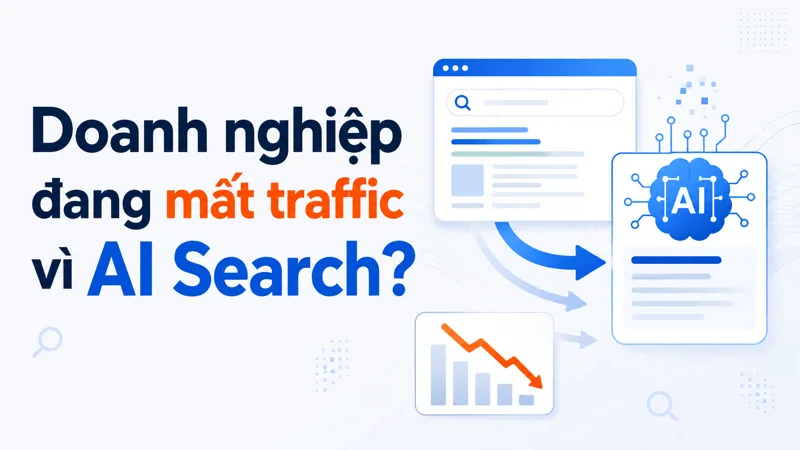
When the answer appears before the click
Google AI Overviews, AI Mode and tools such as ChatGPT and Gemini can compile information from many sources and present an answer right there in the search or chat interface. Rather than having to open several websites, the user can read the compiled answer, ask a few more questions and only visit the original source when they need to research more deeply.
The scale of this change is no longer small. At Google I/O 2025, Google said AI Overviews had reached around 1.5 billion monthly users across 200 countries and territories. Google also said that in large markets such as the United States and India, the group of queries carrying AI Overviews recorded more than 10% growth in Google usage. These are figures published by Google itself, so they reflect the scale of product usage rather than an independent measurement of the effect on website traffic.
What is notable is that users may search more while the number of clicks through to websites falls. The two trends can perfectly well occur at once.
A Pew Research Center study published in July 2025 offers a fairly clear view of this. Pew analysed 68,879 Google searches by 900 adults in the United States, of which 12,593 queries produced an AI Summary. Where an AI Summary appeared, users clicked a traditional search result on about 8% of visits, compared with 15% where there was no AI Summary. The rate of clicking straight through to the sources cited within the AI Summary was only about 1%.
The study also recorded that 26% of searches with an AI Summary ended the browsing session immediately afterwards, against 16% on a traditional results page. These figures do not mean every website loses half its traffic to AI, since the study reflects only a sample of users in the United States over a particular period. But they do show a very notable change in behaviour: once the answer has appeared on the search page, the need to click through for more tends to fall.
Not every kind of traffic is affected the same way
What matters is that businesses should not look at AI search through a single average figure.
Simple informational queries are likely to be affected more strongly. If a user asks “What is a CRM?”, “How does SEO work?” or some other general-knowledge question, AI can usually compile enough information to meet the need immediately.
But the search journey does not stop at simple questions.
When a user needs to choose a supplier, research a high-value product, look at a detailed price list, verify a company’s capability, read a case study or complete a transaction, the website still plays roles that a compiled AI passage cannot fully replace.
Google also describes AI Mode as a tool suited to queries requiring deep exploration, reasoning or complex comparison. According to the Search Central documentation, AI Overviews and AI Mode can run several related queries to find pages supporting the answer, then display links helping the user explore further.
So rather than saying “traffic will disappear”, it is perhaps more accurate to say that the structure of traffic is changing.
Part of the top-of-funnel traffic may be retained by AI. The visits that remain may concentrate more on people who need to verify, research deeply or are moving close to a purchase decision.
This is an important change for business, because 10,000 visits of a browsing nature are not necessarily worth more than 3,000 visits from people with a clear need.
A website can have an influence even without receiving a click
AI search also creates another paradox: a website can take part in the buying journey without seeing that whole journey in Google Analytics.
Suppose a customer asks AI about “AI chatbot solutions suitable for a retail business”. The system can search and compile information from many sources before offering a few options. The user can read the answer, keep asking AI to compare, and then visit only one or two websites at the end.
In that case, many websites have contributed data to the search journey without receiving a corresponding click.
This is why the idea of visibility – how present you are is becoming more important alongside traffic.
Google is also starting to reflect this change in how it measures. In June 2026, Google launched a trial of a separate Generative AI report in Search Console for a group of websites, allowing them to track how many times a URL appears in AI experiences such as AI Overviews and AI Mode. This report focuses on impressions and visibility, alongside traditional search performance data.
That is a notable signal. Where the question used to be “how many clicks does the website receive?”, in future businesses may have to add another: “Where is our content appearing within AI-driven search experiences?”
Falling traffic does not necessarily mean falling effectiveness
This is perhaps the point businesses need to look at most soberly.
Traffic still matters a great deal. There is no reason to treat website visits as an obsolete metric. Google Search Central still recommends that businesses track clicks, conversions and time on site in order to assess the effectiveness of Search. Google has also said the foundational SEO principles continue to apply to AI Overviews and AI Mode.
But if AI is removing part of the clicks that only served to fetch a quick answer, a fall in organic traffic does not necessarily mean a corresponding fall in business results.
What needs following more deeply is the quality of the traffic that remains. How many become leads? How many buy? How much has brand search risen? Do customers mention having found the business through AI? And when users ask AI about the business’s field, does the brand appear among the options or is it absent altogether?
That is when SEO has to move from a search traffic mindset to a broader idea: search visibility.
From a race for clicks to a race for presence
In the old search model, websites mainly competed for position on the results page.
In the new model, businesses will compete across more layers: being indexed by Google, being ranked, being understood correctly by AI, being used as a source, being mentioned in the answer and finally being chosen by the customer.
This does not mean SEO, websites or traffic become less important. On the contrary, Google itself confirms that a page wanting to appear as a supporting link in AI Overviews or AI Mode must first be indexed and eligible to appear in Google Search. Google has also said there is no separate mandatory set of “AI SEO techniques”; the traditional SEO foundations such as useful content, crawlability, internal linking, page experience and structured data continue to have value.
To my mind, this is the most appropriate way for businesses to assess the change now under way.
AI search may take away part of the traffic. That has begun to appear in the data and should not be taken lightly.
But losing some clicks is not necessarily the biggest risk.
The bigger risk is that customers keep searching, AI keeps producing answers, and your business does not appear in those answers at all.
In the new era of search, the question is therefore no longer only:
“How much traffic does my website have?”
It will gradually become:
“Where is my business present in the customer’s journey of searching and deciding?”
Traffic is still part of the answer.
But it will probably no longer be the whole answer.
