
E-commerce is entering a new phase of transformation, where competition is no longer simply about product price or advertising budget but about the ability to operate on data and artificial intelligence. As user behaviour changes rapidly, AI is gradually becoming the “core infrastructure” of many e-commerce businesses rather than merely a support tool.
According to Shopify’s “Future of Commerce” report, as many as 41% of retail businesses had already been actively integrating AI into their operations by 2024. This is no longer a matter of trialling technology but a question of optimising cost, accelerating growth and improving customer experience in an increasingly fierce competitive environment.

For many years, e-commerce businesses expanded by adding staff to operations, customer care, content writing or inventory management. With AI, that model is changing very quickly. A good AI system can help a business handle thousands of products, respond to customers 24/7, personalise the shopping experience and automate marketing without a corresponding increase in headcount.
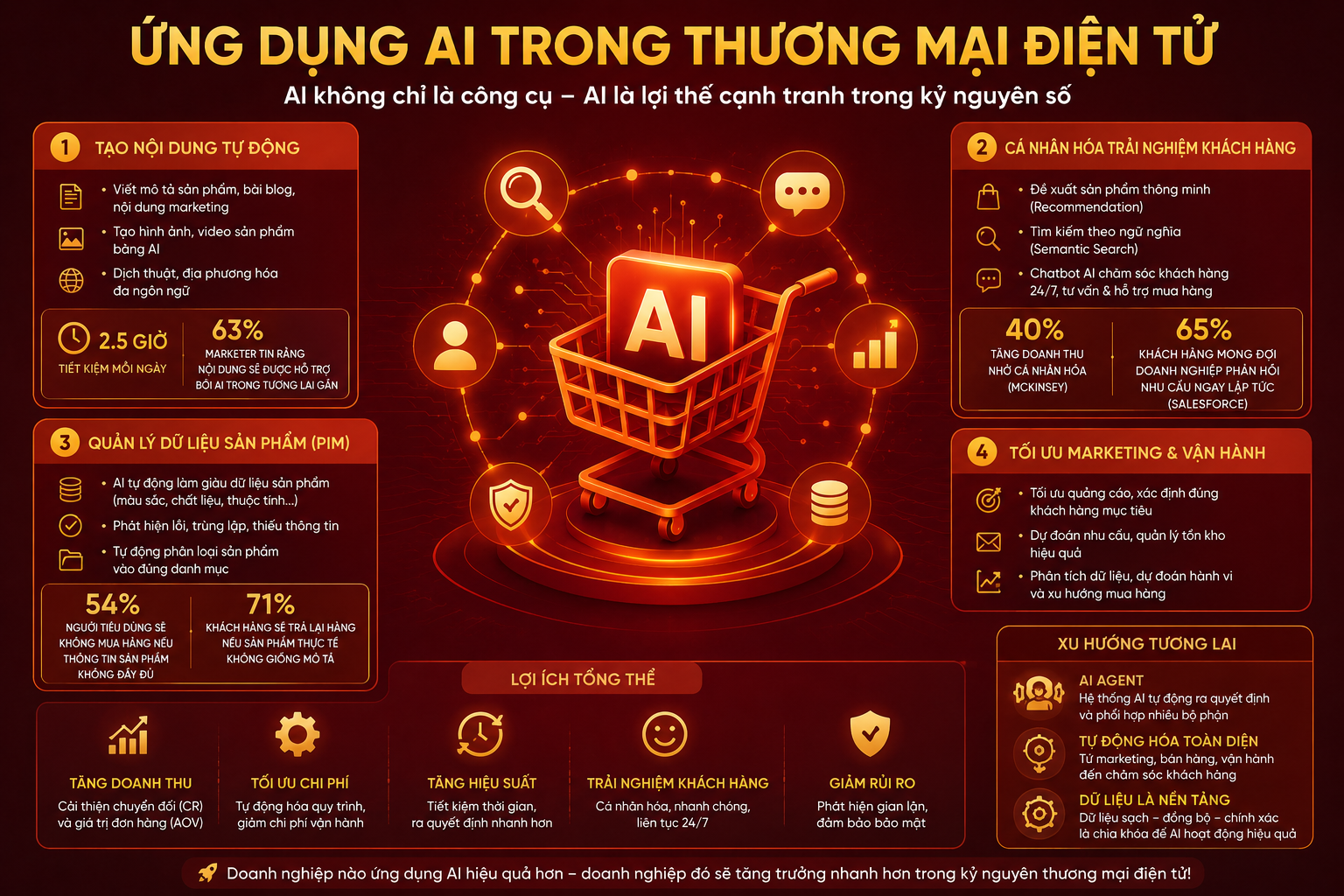
Generative AI in particular is creating a major revolution in producing e-commerce content. For businesses with thousands of SKUs, writing product descriptions by hand used to consume a great deal of time and money. According to a HubSpot survey, marketers using AI save an average of about 2.5 working hours a day on repetitive tasks. At the same time, 63% of marketing professionals believe most commercial content in future will be supported by generative AI to ensure speed and brand consistency.
It does not stop at text: AI can now generate product images in context without organising a traditional photo shoot. This trend is particularly notable in fashion, cosmetics and furniture — sectors where imagery directly affects the order conversion rate.
Many international businesses now use AI to produce “lifestyle images”, showing the product in real settings to heighten the emotional pull of buying. Instead of hiring a studio, models and a post-production team and waiting several days for the finished set, a business can generate hundreds of image variants in a few minutes.
Alongside content, AI is also completely changing the shopping experience. Where e-commerce websites once worked on a “show everything” model, the trend now is “hyper-personalisation” based on each customer’s behaviour.
A McKinsey report shows that businesses doing personalisation well can raise revenue by up to 40%. Salesforce, meanwhile, records that around 65% of customers expect a business to understand and respond to their needs in real time.
That explains why AI recommendation systems are becoming central to many large e-commerce platforms. AI does not only suggest products from purchase history but analyses browsing behaviour, time of visit, device used and search context in order to make suggestions closer to the actual need.
Another notable change is the growth of a new generation of AI chatbots. Where a traditional chatbot works only from a fixed script, today’s AI chatbot can converse naturally, like a real salesperson. According to figures cited by Business Insider, around 85% of customer interactions in future will be handled by AI automation systems.
This not only takes load off the customer care department but opens up automated selling 24/7 at a far greater scale than the traditional operating model allows.
In Vietnam this trend has grown markedly stronger over the past two years. Many businesses are beginning to realise that AI is not only for large technology groups but can be applied practically in small and medium-sized models if it is deployed properly.
From T3SKY’s perspective, AI in e-commerce should not be seen as an “optional plugin” but needs to become part of the business’s operating architecture. The greatest value of AI lies not in “answering intelligently” but in its ability to process data, automate processes and optimise operational performance in real time.
AI is not a “magic wand” that can solve every problem if the business lacks a foundation of standardised data, however. A powerful AI system with inaccurate, incomplete or inconsistent product data will still produce poor results. A report from Salsify shows that 54% of consumers will not buy if product information is incomplete or inaccurate, and 71% of customers are likely to return an item if the actual product does not match the online description.
That is also why many businesses are now shifting from “buying AI” to “building the data infrastructure that lets AI work effectively”.
In the next phase, AI is expected to move beyond chatbots and content generation towards AI agent models — where the system can analyse data on its own initiative, make operational decisions, optimise advertising, manage stock and coordinate between departments without constant manual intervention.
E-commerce is entering a period in which the business with better data and more effective use of AI will hold a long-term competitive advantage. The new game is no longer about who advertises more, but about who operates more intelligently.
