
A small change in language, but a very large one in behaviour
There is an interesting change taking place on the internet that many people may not have really noticed.
About ten years ago, whenever someone needed to find something out, the familiar answer was always: "Google it."
Today that phrase is gradually being replaced by: "Ask ChatGPT."
The change has happened very naturally. There is no particular moment marking the point where users abandoned Google for AI. Yet in under three years since ChatGPT launched, asking an AI directly has become a habit for millions of people worldwide.
That points to a notable truth: the way people search for information is changing.
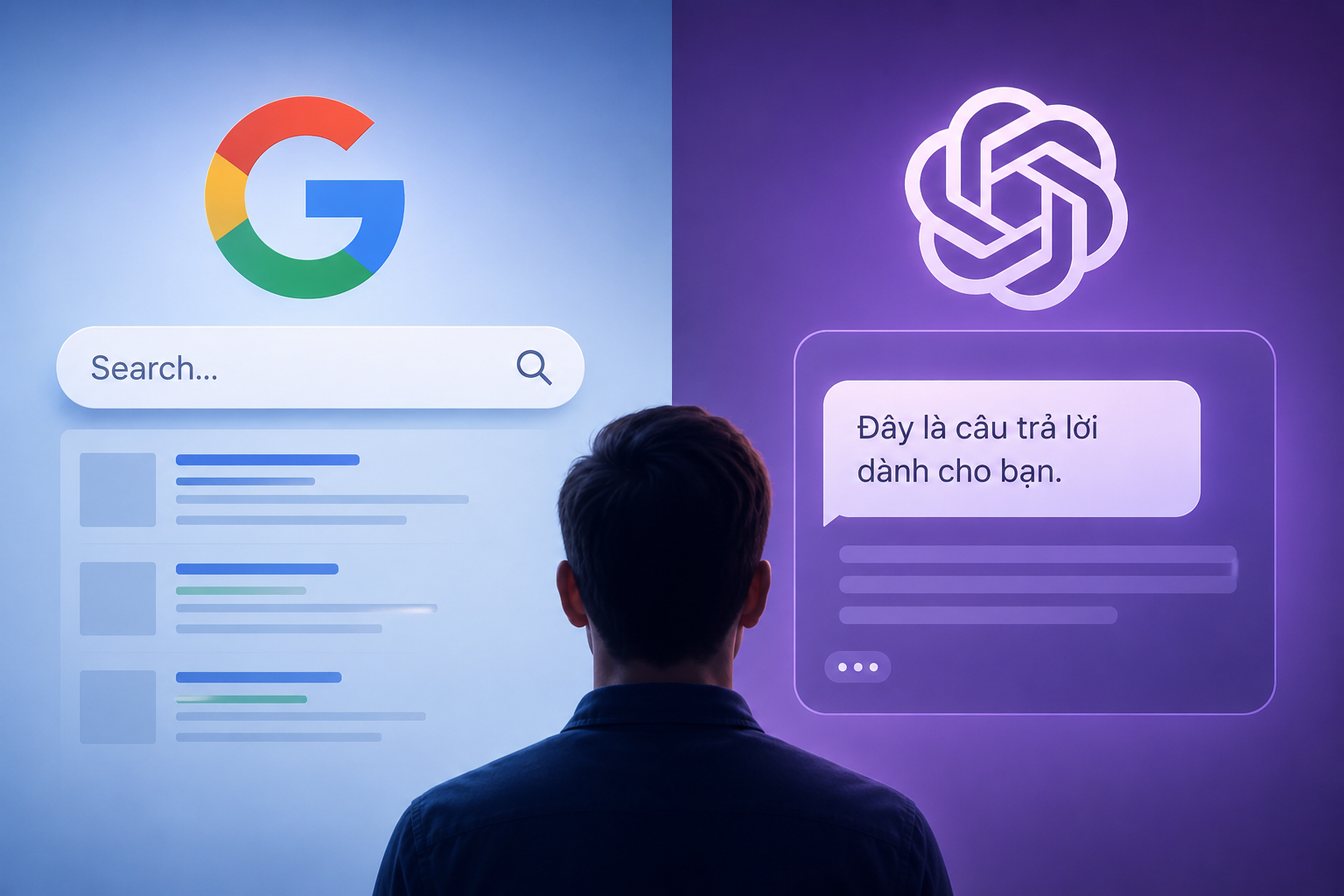
Google has not failed, but the way people search is changing
Looking at the figures alone, it is hard to conclude that AI is replacing Google.
According to OneLittleWeb, between April 2023 and March 2025 Google recorded roughly 1.63 trillion visits, equivalent to nearly 4.7 billion visits a day. Over the same period ChatGPT reached about 47.7 billion visits, or roughly 185 million a day. Google’s scale remains about 26 times that of ChatGPT.
Clearly, Google is still the largest search engine in the world.
These figures, however, do not capture the whole nature of the change.
For more than twenty years Google has played the role of helping people find information. Enter a query and you receive dozens of links, read several sources and synthesise a conclusion yourself.
AI works differently.
Instead of helping the user find documents, AI helps them synthesise knowledge. The reading, comparing and summarising all happen within the conversation. The user no longer has to decide which website to open first or which source to trust more. They receive a complete answer straight away.
That is the most important difference between a search engine and generative AI.
People never actually wanted to "search"
Seen more broadly, this change reflects what people genuinely need.
When we want to know something, we have never wanted to spend time opening ten websites, reading them and synthesising the answer ourselves. What we actually want is a fast, accurate and trustworthy answer.
For many years, Google was the best way to get that.
Today AI is taking one further step that traditional search never did: reading, understanding and interpreting information on the user’s behalf.
AI is therefore not merely a new tool. It is changing what people expect of how the internet should work.
The impact will not stop at Google
This change in search behaviour will have a far greater effect than whether one particular tool is used more or less.
For more than two decades, businesses have focused on optimising their websites to appear on Google. SEO became one of the most important activities in digital marketing.
But as more and more people begin with a conversation with an AI, the question businesses need to answer will change too.
Instead of worrying only about how to get their website to the top of the search results, businesses will have to think about how to make sure AI understands their brand, products and services correctly.
Several research organisations have forecast this trend. Gartner suggests that by 2026 search volume on traditional engines could fall by around 25% because of the growth of AI chatbots and intelligent assistants. Meanwhile many businesses are already recording a fall in organic traffic for informational queries as AI increasingly answers directly rather than sending the user to a website.
That does not mean the website loses its value. On the contrary, the website is shifting from being somewhere people go to read information to being a data source for AI to reference and verify information against.

My own view
In my view this is only the beginning.
Google will not disappear, just as the website will not disappear. But their roles are changing.
Where businesses once competed to be the first result on Google, in future they will compete to be the first source of information the AI chooses when generating an answer.
That is no longer a game for SEO alone but a game of data, credibility, brand and content quality.
Perhaps the most important question a business should be asking from today is no longer:
"How do customers find us on Google?"
but rather:
"How do we make sure AI understands our business correctly?"
Because in a world where AI is gradually becoming the starting point of every search journey, the business the AI understands correctly stands a chance of being found by customers first.
