
For many years, businesses grew by a familiar formula: hire more people, expand the operations team and invest in more management software. Headcount was almost always proportional to revenue.
But that model is starting to change.
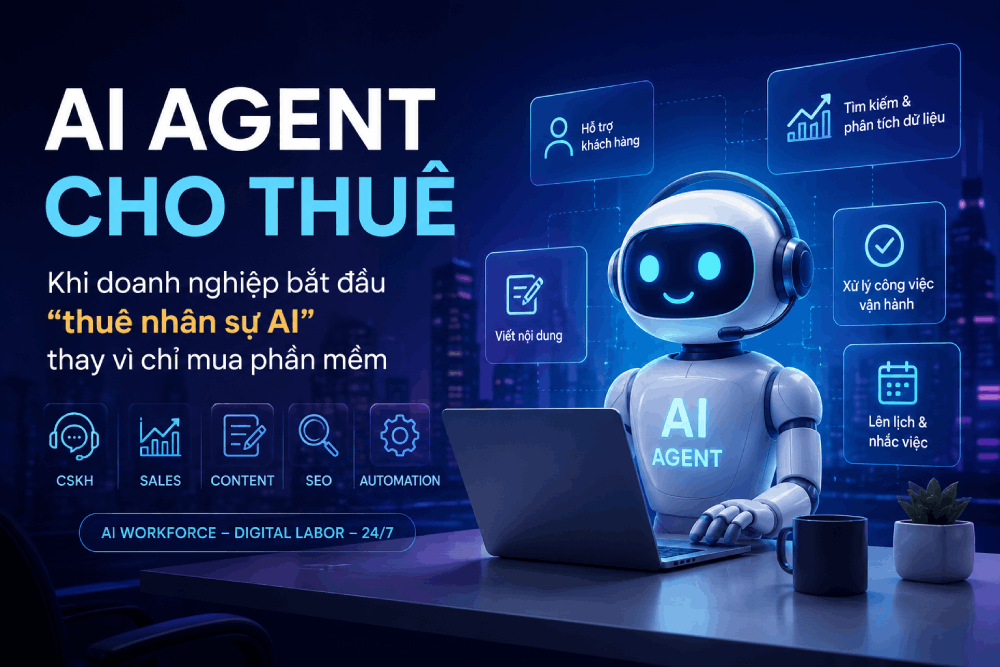
A new wave of technology called the “AI agent” is convincing the international technology world that the business of the future may be able to operate with far fewer staff while still handling work at a larger scale than before. Companies no longer only buy software for their staff to use; they are beginning to “hire” AI agents as a form of digital labour working 24/7.
The idea of “renting an AI agent” is therefore appearing more and more often on the global technology market.
From AI that answers to AI that acts
In the first phase of the generative AI wave, most businesses met AI in the form of a chatbot or a content-writing assistant. AI at that point mainly played a supporting role: responding and offering suggestions.
But according to McKinsey’s latest report, the market is moving into an “agentic AI” phase — where AI no longer merely converses but begins to carry out work directly.
McKinsey describes this as the shift from:
“machines that chat”
to:
“machines that act”.
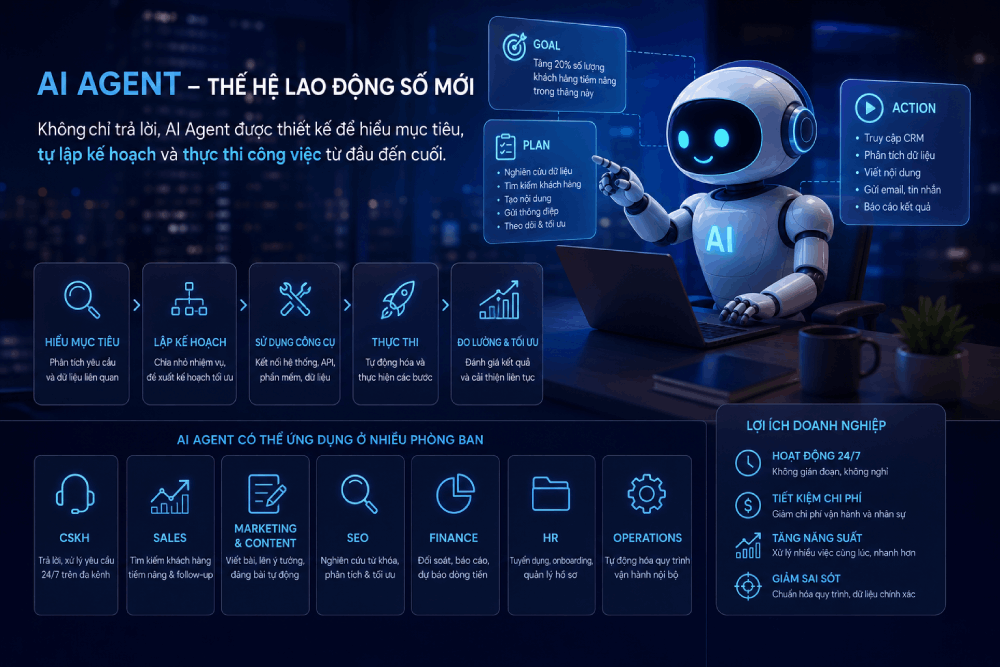
That means AI can:
- analyse a request itself,
- break it into smaller tasks,
- connect data,
- use tools,
- operate a workflow,
- and take the next action without a person directing every step.
This is a very large difference between:
- an AI chatbot,
and: - an AI agent.
An ordinary chatbot answers questions. An AI agent, by contrast, is designed to complete work.
The big technology firms are changing direction very fast
What is notable is that almost the whole of Big Tech is now moving in the direction of AI agents.
Microsoft is one of the companies pushing this trend hardest. In its recent Work Trend Index report, Microsoft introduced the term “Frontier Firm” to describe businesses restructuring their operating model around AI agents.
According to Microsoft, competitive advantage in future will not lie in whether a business “has AI or not”, but in:
how deeply AI takes part in the running of the business.
Rather than only helping draft emails or produce content, AI is being built into:
- CRM,
- finance,
- reporting,
- operations management,
- customer care,
- sales workflow,
- internal data management.
This shows AI gradually becoming a “layer of digital labour” inside the business.
Salesforce is turning AI into a “CRM employee”
One of the clearest examples today is Salesforce Agentforce.
Rather than positioning it as a chatbot, Salesforce calls Agentforce a platform of AI agents able to:
- read customer data,
- track interaction history,
- handle tickets,
- follow up with customers,
- coordinate the sales workflow.
In other words, this is close to the model of:
“an AI CRM employee”.
Salesforce even uses the phrase:
“digital labor”
to describe this trend.
In many enterprise reports, AI agents are no longer regarded as a software feature but are being seen as: a new workforce.
From SaaS to the “AI workforce”
The past ten years or so have been the era of SaaS — businesses buying software to optimise their processes.
But a new way of thinking is now appearing in the market:
businesses no longer want to learn how to use software; they want AI to do the work itself.
This is why many international AI startups are shifting their narrative from:
- AI Platform
to: - AI Workforce,
- Digital Employee,
- Virtual Coworker.
Cognition Labs, with its Devin AI Engineer, is a typical example. Devin is positioned as an “AI software engineer” able to handle a range of programming work in place of a developer on certain tasks.
Meanwhile Harvey AI is developing AI agents for the legal sector, while Adept AI focuses on having AI operate software directly in place of a person.
What these products have in common is:
AI no longer only supplies information but begins to take direct part in operations.
Why is the “rent an AI agent” model easier to grasp in Vietnam?
In Vietnam, many businesses still see “deploying AI” as a fairly distant idea with a technical colouring.
But when the approach is reframed as:
- hiring an AI salesperson,
- hiring an AI content writer,
- hiring an AI customer care agent,
- hiring an AI SEO specialist,
the problem becomes a great deal easier to understand.
The business does not need to care about:
- what an LLM is,
- what a vector database is,
- how prompt engineering works.
They care only about:
- Which role is this AI standing in for?
- How much cost does it save?
- Does it generate extra revenue?
- Can it run continuously?
This is also why the “AI agent as a service” model is growing very fast on the international market.
Vietnamese SMEs may be the group that benefits most
Unlike large corporations with the resources to build an internal AI team, most small and medium businesses in Vietnam share the same problem:
- a shortage of staff,
- difficulty scaling operations,
- rising recruitment costs,
- while still having to run across multiple platforms 24/7.
Against that background, the AI agent becomes a very practical solution.
One AI agent can:
- staff the fanpage,
- answer on the website,
- look after leads,
- support sales,
- write content,
- compile reports,
- search internal data,
- or help run an operational workflow.
What matters is that the business does not need to invest in an overly complex AI system from the outset. They can approach AI in the form of:
“hiring by function”.
This may be why the “AI agent for hire” model will grow a great deal more strongly over the next few years.
But the market is still at a very early stage
Although the AI agent is a hot trend, the market is not yet genuinely mature.
Many products today are in reality still only:
- a chatbot combined with a workflow,
- automation with AI,
- or an advanced RAG system.
Whereas a true AI agent needs several more complex components:
- memory,
- planning,
- reasoning,
- orchestration,
- state management,
- the ability to use tools across multiple steps.
Recent research shows AI agents still run into plenty of errors when handling long workflows or real environments with many variables.
That shows the market is only at the beginning of this process of change.
But just as with SaaS more than a decade ago, the companies that move early in this phase may become the new operating infrastructure of the business of the future.
The T3SKY view: the AI agent is no longer a feature but a new operating model
At T3SKY we believe the AI agent is not simply a short-term technology trend.
This is the shift from:
“a business that uses software”
to:
“a business that operates alongside AI”.
In the near future, many businesses may no longer expand headcount in the traditional way. Instead they will combine people with AI agents specialised for each function:
- AI SEO,
- AI Content,
- AI customer care,
- AI Sales Assistant,
- AI Knowledge Agent,
- internal AI automation.
At that point, competitive advantage will no longer lie in how many staff a business has, but in:
how effectively the business runs its AI system.
And it is quite possible that “the AI agent for hire” will become one of the fastest-growing technology models in the next phase of enterprise digital transformation.
