
Every time a new technology appears, the familiar question is asked again: “Will the website still exist?”
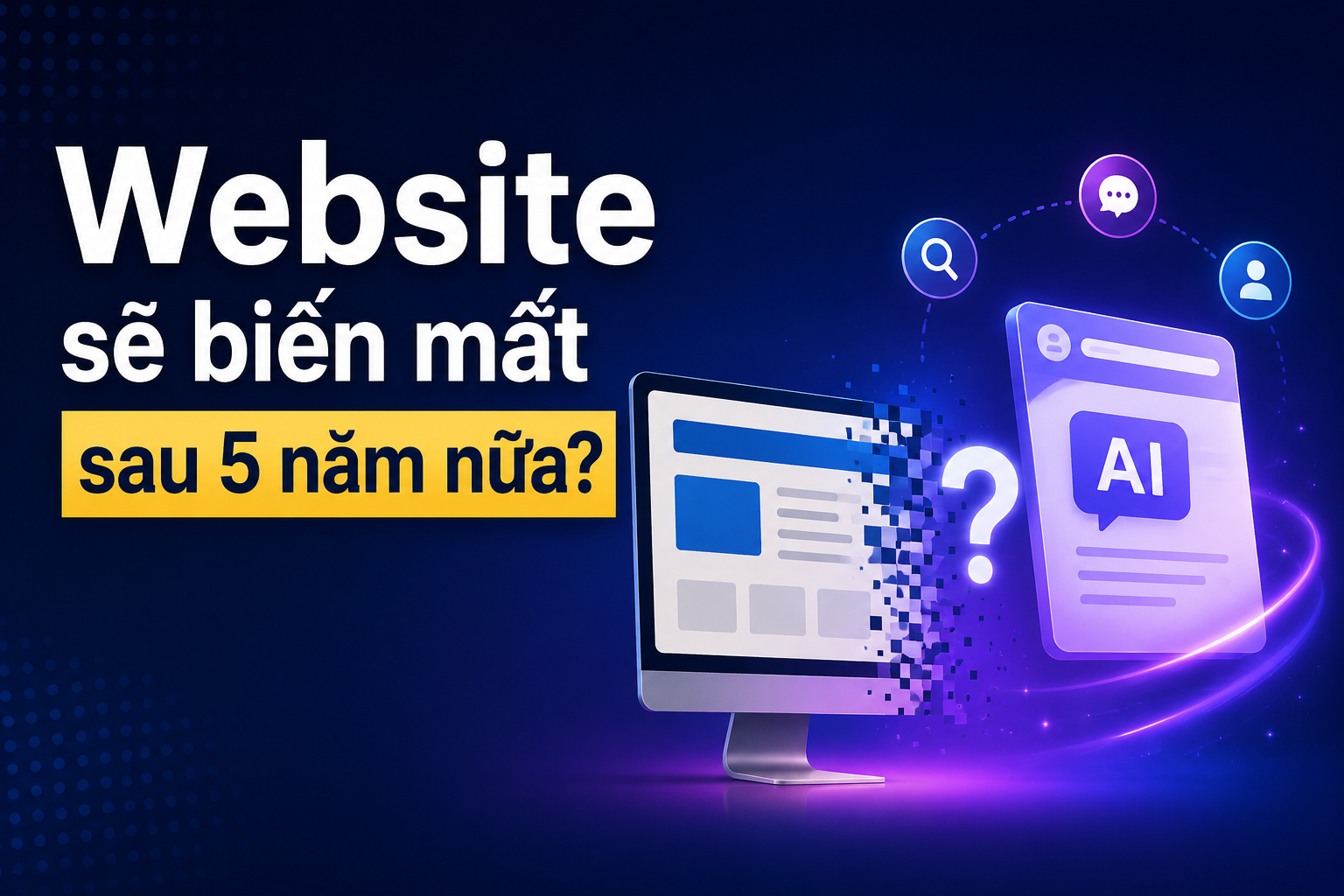
When social media exploded, many people believed the fanpage would replace the website. When mobile apps grew strongly, plenty of businesses believed an app alone was enough. And since artificial intelligence platforms such as ChatGPT, Gemini, Claude and Perplexity became widespread, a new prediction has appeared: AI will make the website disappear.
On the face of it, that seems reasonable. Users increasingly tend to put a question straight to AI and get an answer immediately, rather than opening dozens of web pages to search and pull the information together themselves.
But looking deeper, what is gradually disappearing is perhaps not the website but the way people use the website.
The website will no longer be the first destination
For more than two decades the website has been the centre of the digital world. Users visited a website to read information, research a product, buy something or contact a business.
Today that journey is changing.
Rather than going directly to each website, users can ask AI:
“Which website design firm is reputable?”
“Which type of wood flooring suits a house with young children?”
“Which hotel is near the beach, has a pool and suits a family?”
AI compiles information from many different sources and gives a short answer. Users visit a website only when they need to see the detail, verify the information or complete a transaction.
That means the website may no longer be the starting point, but it remains one of the most important original sources of information.
AI is not replacing the website; AI is using the website
This is a very important distinction.
AI systems need data, references and trustworthy signals in order to produce an answer. A business’s official website is one of the important places from which AI works out who that business is, what products or services it provides, what it is capable of and which information is official.
If a business has no website, or the website is thin, out of date and inconsistent, AI will have more difficulty understanding that business correctly.
In other words, AI does not make the website meaningless. On the contrary, AI is bringing out a new role for the website: becoming the official data source that search platforms and artificial intelligence systems refer to.
The website is the business’s “source of trust”
In the digital environment, information about a brand can appear in a great many places: social networks, e-commerce marketplaces, the press, forums, review sites, video or user-generated content.
Most of these channels, however, are not entirely under the business’s control. Information may be incomplete, inaccurate, out of date or presented in a way that does not match the brand’s positioning.
The official website therefore acts as a central source of verification, or what might be called the source of trust.
This is where the business publishes its legal name, its capability, its products, services, policies, team, completed projects, contact details and its expert content.
When a customer, partner, investor, search engine or AI wants to verify a piece of information, the official website is usually the reference of highest value.
A well-maintained website does not only help a business “be present on the internet”. It helps the business prove that it genuinely exists, operates transparently and has clear capability.
In future, as AI-generated content grows and the risk of misinformation increases, this verifying role of the website will become all the more important.
The website is the business’s own branding channel
Social media is a very effective distribution channel, but it is still “rented land”.
The business has to follow the algorithm, the policies, the formats and the display rules the platform lays down. Reach can change at any moment. An account can be restricted, lose access or see engagement fall in ways the business cannot fully control.
The website is different.
It is the brand’s own space, where the business decides how it appears to customers.
From imagery, language and brand story to user experience and the way products and capability are presented, all of it can be designed consistently around a long-term positioning.
The website does not only answer what the business “sells”; it also shows who the business “is”, what it “believes in” and “how it differs”.
For businesses in services, technology, consulting or B2B, the website is also part of the capability profile. Before getting in touch, customers usually look at the website to judge the supplier’s professionalism, scale, thinking and reliability.
So even if direct traffic to the website may change in future, the value of the website as a brand asset owned by the business remains intact.
The value of a website is changing
For many years the value of a website was usually judged by an attractive interface, page loading speed or traffic from Google.
Those factors still matter, but they are no longer everything.
In the coming years, the value of a website will lie more in the quality of its content, the accuracy of its information, how trustworthy it is and how fully it reflects the business’s capability.
A website containing full information on products, services, policies, frequently asked questions, expert material, real projects and company details will have more chance of being used as a reference by customers, search engines and AI systems.
It could be said that the website is shifting gradually from the role of an information display channel to a digital knowledge store, a source of verification and a brand asset of the business.
The visitors to a website in future may not only be people
This is perhaps one of the most notable changes.
Imagine a few years from now, when AI assistants are more widespread. The user only has to give an instruction:
“Find me a laptop under 25 million dong, suitable for programming and able to be delivered this week.”
Rather than searching themselves, the user can let AI help compare products, check the information, judge how suitable each is and recommend a choice.
In that case AI becomes an intermediary layer between the user and the business.
The website still exists, but its role is not only to serve the direct reader. It also has to provide clear, consistent and trustworthy information so that the intermediary systems can understand the business correctly.
The website will become part of the business’s infrastructure
Where the website once mainly served communications and marketing, in future it will be bound ever more closely to operations.
The website can connect to systems for customer management, orders, appointments, inventory, payment, customer care and AI assistants.
At that point the website is no longer only the business’s “face” on the internet. It becomes part of the digital infrastructure that helps the business communicate, serve customers and expand its operations.
What should businesses prepare?
Rather than asking “do we still need a website”, businesses should ask more practical questions:
Does the website reflect the business’s capability and brand positioning accurately?
Is the information on the website complete, accurate and regularly updated?
Can customers use the website to verify how reputable the business is?
Can search engines and AI systems clearly understand what value the business provides?
Preparing for the future of the website does not necessarily begin with complex technology. First of all, the business needs to build an official source of information that is transparent, consistent and substantial.
Conclusion
The website will not disappear in five years.
What may gradually disappear is the old way of thinking, in which the website was regarded only as a company introduction page or a place to attract visits.
In the age of AI, the website will play several roles at once: an official data source, a trustworthy source of verification, a digital knowledge store, connecting infrastructure and the business’s own brand-building channel.
Social media can help a business reach customers faster. E-commerce marketplaces can make selling more convenient. AI can help users search and decide faster.
But the website is still where the business defines itself, owns its own story and publishes the most official information about itself.
So the right question is perhaps not:
“Will the website disappear?”
But:
“Is the business’s website trustworthy enough, distinctive enough and valuable enough for both customers and AI to come to it?”
