
Businesses have a great deal of data but not enough knowledge
For years, businesses have invested heavily in digital transformation in the expectation that data would become their most important asset. CRM systems were rolled out, ERP was extended, ever more customer data was stored, and thousands of emails, reports, meeting minutes and operating documents were produced every month. Yet as the volume of data grew, a paradox began to appear: the business holds a great deal of information but lacks a system capable of “understanding” everything happening inside the organisation.
Most data today still exists in scattered form. Insight from the sales team sits in meetings, operational know-how sits in individual people, and strategic decisions are broken up across emails, slide decks and internal conversations. As a business scales, this fragmentation becomes ever more pronounced. Finding information takes time, the ability to pass knowledge on declines, and more than a few businesses begin to face “organisational memory loss” when key staff leave.
The new direction for AI: from chatbot to knowledge operating system
This is why, in recent times, many of the world’s large technology groups have begun shifting their AI research away from plain chatbot models towards a deeper idea: building an “enterprise knowledge operating system”.
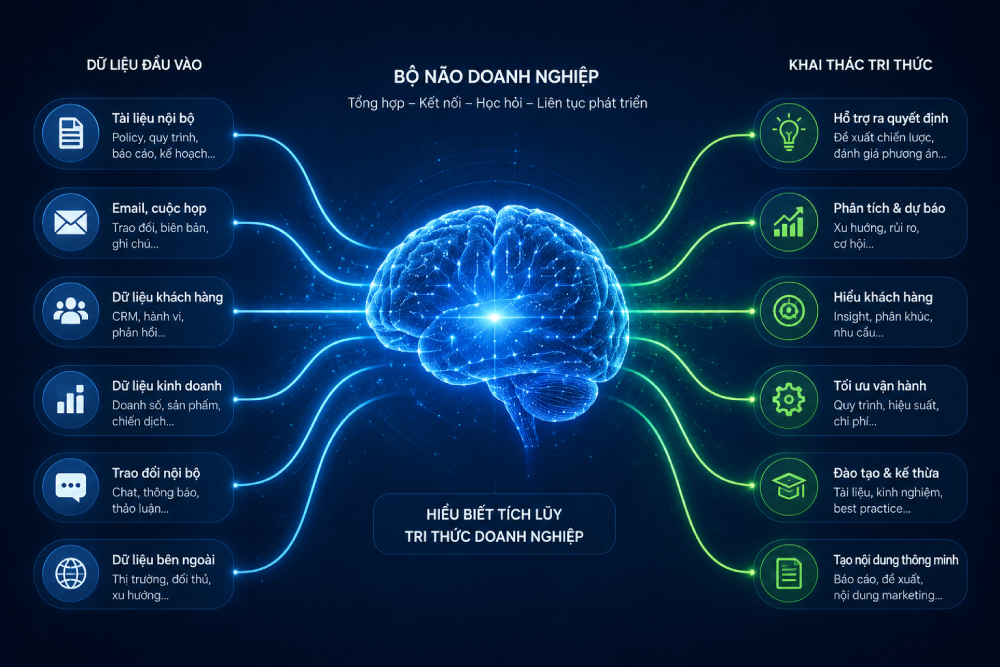
In this model, AI does not stop at answering questions but becomes a layer of intelligence able to synthesise data continuously, connect information and maintain understanding over time. Unlike the previous generation of AI, which worked on a “search then answer” basis, the new model aims at accumulating knowledge for the long term.
With each new document added to the system, the AI does not merely store it for retrieval but analyses the content automatically, links it to existing data, updates the related context and adjusts the system’s overall understanding. Over time the business builds up a digital knowledge layer that reflects, in reasonably complete form, its customers, market, products, processes and even the operational decisions taken previously.
That creates an enormous difference between a system where “the AI can find information” and one where “the AI genuinely understands the business”.
What businesses actually need is not an AI that can answer
Over the past few years, most businesses have approached AI as a customer service chatbot, a content generator or a way to automate simple tasks. But as AI becomes commonplace, competitive advantage will no longer lie in whether a business uses AI, because virtually every business will deploy it to some degree.
The real difference will lie in which business builds a knowledge layer deep enough for the AI to understand how the organisation actually runs.
An AI system capable of “understanding the business” creates value quite different from an ordinary chatbot. When the marketing team needs to build a new strategy, the AI does not merely produce content but can pull together data on customer behaviour, analyse the performance of past campaigns, track market movements and identify search trends in order to offer a more strategic perspective.
In sales, the AI can retrieve the entire history of correspondence with a customer, summarise their previous needs, identify problems that have arisen and suggest opportunities still open. In internal operations, the AI can also detect process bottlenecks, spot duplication between departments or warn when important knowledge depends too heavily on one particular person.
AI is moving from “support tool” to “knowledge operating layer”
In the next phase, the greatest value of AI may lie not in the speed at which it produces content or its conversational ability but in its capacity to maintain knowledge, connect data and help the business keep learning over time.
This is a very large shift in how businesses regard AI. Previously AI was seen mainly as a tool to help an individual. But in the near future AI will gradually become part of the operating structure of the business — where data is not merely stored but converted into knowledge capable of developing continuously.
Businesses that build a sufficiently deep internal intelligence layer will begin to make decisions faster, adapt better to the market, train staff more effectively and maintain continuity as they scale.
The view from T3SKY
At T3SKY we believe this will be one of the most important directions for enterprise AI over the next few years. AI will not stop at the role of chatbot or content tool but will gradually become the knowledge brain of the business — bringing together all operational data, connecting scattered understanding and helping the business build a long-term advantage on accumulated knowledge.
At that point the most important question will no longer be “how much data does the business have” but:
“Can the business turn its data into understanding?”
