
Over many years, e-commerce and social media platforms have become the “golden land” of millions of Vietnamese sellers. From individuals selling by livestream to large-scale businesses, most have chosen to grow through ecosystems such as Shopee, TikTok Shop, Lazada or Facebook.
The growth of these platforms has completely changed consumer behaviour in Vietnam:
- Users are used to buying right inside the app
- Livestreaming has become a common sales tool
- Vouchers and free shipping create a strong buying impulse
- Small businesses can reach customers quickly without large investment in infrastructure
But as the market moves into a phase of higher competition, many signs suggest that the model of depending entirely on the platforms is revealing quite a few limitations.
The platforms hold nearly the whole “front door” of e-commerce
According to a Momentum Works report in 2025, total platform e-commerce GMV in South-East Asia reached about 157.6 billion USD. Of that, the three “giants” – Shopee, TikTok Shop/Tokopedia and Lazada – accounted for nearly 98.8% of the platform e-commerce market share across the region.
This shows that:
- Marketplaces control most online shopping traffic
- SMEs are virtually obliged to join a platform in order to have customers
- The power of the algorithm and of concentrated traffic keeps growing
In Vietnam this trend runs even more strongly thanks to the boom in social commerce. Many businesses today can generate large revenue purely through livestreaming, short video or advertising campaigns on social media.
For a good many sellers, “opening an online shop” is virtually synonymous with:
- Opening a stall on a marketplace,
- Creating a fanpage,
- Or livestreaming on TikTok.
In many cases the business’s own website plays only the role of brand presence rather than being the centre of e-commerce operations.
Why do businesses still accept ever-higher fees?
Recently, the story of continually rising platform fees has become a much-discussed topic in the seller community. In some South-East Asian markets, the commission and operating fees on platforms have risen considerably over the past few years.
Even so, most businesses keep clinging to the platforms.
The reason lies in a very simple factor:
a platform helps generate revenue considerably faster than building your own system.
An independent e-commerce website has a great many problems to solve:
- Traffic,
- SEO,
- Advertising,
- Payment,
- Logistics,
- Customer care,
- Conversion optimisation,
- CRM and remarketing.
A marketplace, by contrast, supplies virtually the whole ecosystem ready-made:
- A large user base,
- A payment system,
- Logistics,
- Vouchers,
- Affiliate,
- Livestreaming,
- User trust.
This makes the barrier to entry a great deal lower.
For small and medium businesses, particularly with short-term cash-flow pressure growing, accepting a share of the profit in exchange for quick revenue remains an understandable choice.
But what are businesses trading away?
The downside of depending on a platform lies here:
- The business does not own the customer,
- Does not control the algorithm,
- Does not control the traffic,
- And does not hold the user data in full.
In other words:
a business can generate large revenue without genuinely owning the corresponding “digital asset”.
It only takes:
- The platform changing its algorithm,
- Reducing visibility,
- Raising fees,
- Cutting subsidies,
- Or locking the account,
for the whole sales system to be affected almost immediately.
This is also why more and more brands are beginning to invest again in:
- Their own website,
- A CRM system,
- SEO,
- A loyalty programme,
- Customer data,
- And independent operating platforms.
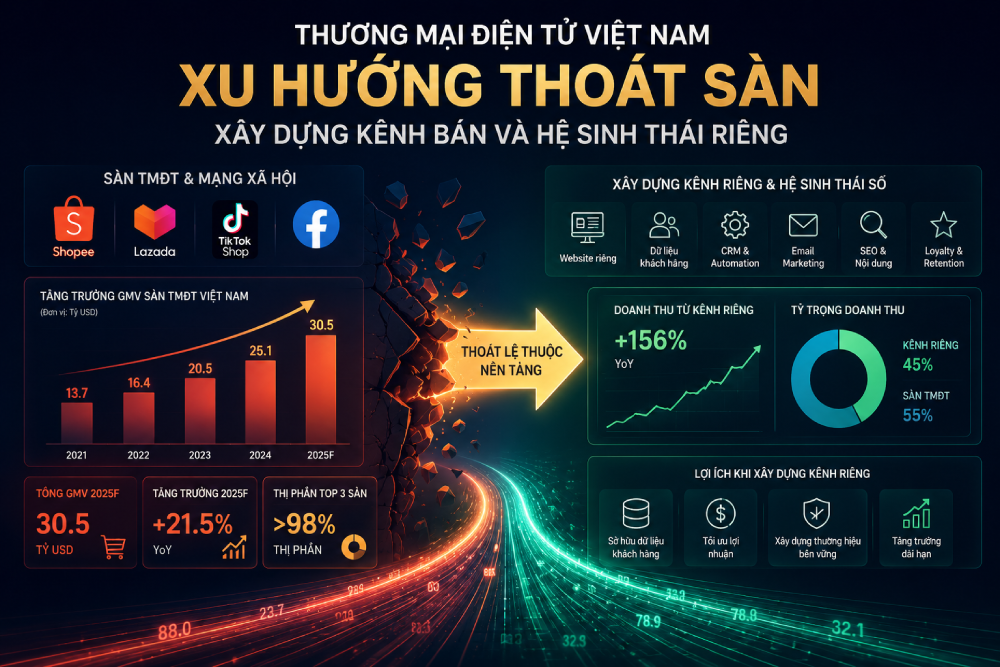
The business’s own website is coming back in a different role
Where the website was once regarded mainly as the “face of the business”, its role in e-commerce is now changing considerably.
The website is no longer simply where products are introduced; it is gradually becoming:
- A customer data centre,
- A care and remarketing system,
- A long-term SEO channel,
- A tool for reducing dependence on advertising,
- And the platform for building an ecosystem of its own.
Particularly as AI develops strongly, many businesses are starting to apply:
- AI chatbots,
- AI SEO,
- AI content automation,
- AI recommendation engines,
- AI CRM
in order to optimise operations on the platforms they own themselves.
This makes a business’s own website a great deal more effective than a few years ago, when the cost of building and running one was still too high.

The new trend: “sell on the marketplace to grow, use the website to keep customers”
According to many e-commerce specialists, the effective model in the coming phase will no longer be a choice between:
- A marketplace or your own website.
Instead it will be the two running in parallel.
In this model:
- TikTok and social media help create demand
- The marketplace helps expand revenue quickly
- The website helps store customer data
- The CRM helps extend the user lifecycle
- SEO helps create sustainable traffic
This is also the trend many businesses in South-East Asia are adopting under the name:
- Hybrid commerce, or omnichannel commerce.
The new game in e-commerce is no longer only about “making sales”
As advertising costs rise, competition over content grows fiercer and the platforms keep changing their algorithms, advantage no longer lies entirely in “producing plenty of orders”.
Instead, businesses are beginning to compete on:
- The ability to own data,
- The ability to retain customers,
- The ability to generate their own traffic,
- And how self-reliant their digital ecosystem is.
Against that background, a business’s own website is returning as part of a long-term strategy rather than merely a “secondary channel”.
The marketplace may keep being a strong engine of growth for years to come. But for many businesses, the more important question now is no longer:
“Where do I get the most orders?”
but:
“How do I avoid depending entirely on a single platform?”
