
Decision 21/2026/QD-TTg, issued in late April 2026, can be seen as an important milestone in Vietnam’s technology strategy. Looking closely at the structure of the list, one line of thinking is very clear: technology is no longer a supporting tool but is being positioned as the core foundation of economic growth.
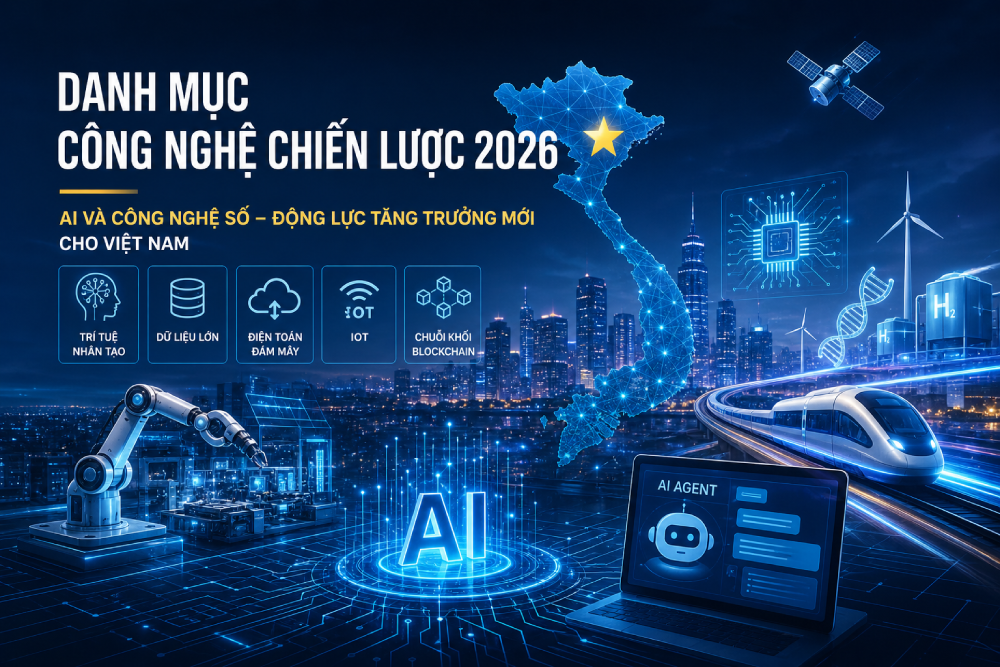
At the centre of the whole system sits digital technology, and artificial intelligence in particular. This list does not stop at “applying AI”; it emphasises building complete ecosystems in which AI, big data, cloud, IoT and blockchain are tightly linked. That reflects the global reality, where value lies not in any single technology but in the ability to run the layers of technology in concert.
Within the group of products that already have a market, AI stands out clearly as a pillar. From large Vietnamese language models to virtual assistants and industry-specific AI, all point to an important shift: AI has moved past the experimental stage to become a component that takes part directly in business activity.
The biggest difference in the current wave of AI lies in the concept of the “agent”. Where a traditional chatbot stops at responding, an AI agent can understand a goal, plan and carry out multiple steps of action to reach a result. Put another way, a chatbot answers, while an agent “works”.
This shift is reshaping how businesses deploy technology. Instead of building systems weighted towards reporting or analysis, many organisations are beginning to put AI into the processes that directly generate revenue or optimise operations.
Against that background, some domestic solutions have begun to move clearly towards “agentification”. For example, T3SKY’s AI Spider platform (aispider.com) is developed on an AI agent model rather than as a plain chatbot. The system does not stop at answering customers but can take part in the entire interaction process.
From an operational standpoint, systems of this kind usually comprise several layers of capability:
- Understanding conversational context and user intent rather than simply following a fixed script
- Connecting to internal data (products, customers, CRM) in order to respond appropriately
- Taking action such as advising, recommending products, even helping close an order
- Remembering and learning from previous interactions to improve performance over time
The important point is that AI no longer stands outside the process but is beginning to become a “digital colleague” taking part directly in business activity. That is also why products such as virtual assistants and industry-specific AI are placed in the group with direct economic impact within the strategic list.
The second group of technologies – semiconductors, quantum, new energy and satellites – plays the role of a long-term foundation. This is the infrastructure layer that AI systems and digital applications will depend on in future. The combination of the two groups points to a two-layer strategy: creating value in the short term while building core capability for the long term.
From a business standpoint, the question is not how to pursue the entire list but how to identify the right position in the value chain. For most businesses today, the application layer – and applying AI to sales and operations in particular – remains the most practical way in.
Platforms such as AI Spider and similar AI agent systems point to a clear trend: digital transformation is entering a new phase in which software does not merely support people but begins to take over part of the operational work. When that happens at scale, the impact reaches beyond business efficiency to the structure of the labour market itself.
 |
|
The 2026 strategic technology list is therefore more than a policy direction. It is a signal of a new phase, in which AI and automated systems are no longer a competitive advantage but are becoming a condition of survival and growth.
