
The year 2026 marks an important turning point in how businesses apply artificial intelligence. After the wave of generative AI brought by ChatGPT, Gemini, Claude…, a new generation of AI is reshaping the way organisations operate entirely: agentic AI — autonomous artificial intelligence able to plan, decide and execute whole chains of work without a human guiding every step.
So what is agentic AI, how does it differ from generative AI, how does it work and how is it being applied in practice? This article answers those questions in full, in terms that a non-technical reader can follow.
1. What is agentic AI?
Agentic AI is an artificial intelligence system capable of operating autonomously — that is, setting its own plan, making decisions and carrying out actions towards a specific goal with minimal human supervision.
If traditional AI is a tool that "answers on command" and generative AI is "a content creator working from a prompt", then agentic AI is a "colleague" that can understand a goal, break the work down itself, use several tools in combination and act until the task is complete.
It can be summed up in a formula:
Agentic AI = reasoning (LLM) + planning + tool use + execution + learning from experience
An illustration
Suppose you ask: "Organise a seminar for 200 customers next month."
- Generative AI would help you: write the invitation email, draft the agenda, suggest topics.
- Agentic AI would itself: check meeting room availability, send a personalised invitation to each guest, track the response rate, send reminders to those who have not confirmed, order catering based on the number registered, produce a report for the organising team — and only ask you when a situation needs your approval.
That is the step change: from "AI that creates content" to "AI that executes a process".
2. The difference between agentic AI, generative AI and a traditional chatbot
This is where most people get confused. Let us separate the three concepts clearly:
Traditional chatbot (rule-based)
- Works from a script (if-this-then-that).
- Answers only the questions it has been programmed for.
- Does not understand context and cannot handle variables.
- Role: answering FAQs.
Generative AI
- Uses a large language model (LLM) to produce new content.
- Reacts to a prompt — you ask for something and it produces it.
- The end product is text, images, code or video for a person to use next.
- Role: content creator.
Agentic AI
- Uses an LLM but adds the ability to plan, use tools and execute.
- Actively breaks a goal into smaller steps and carries them out itself.
- Can retain long-term context, learn from feedback and adjust its strategy.
- Role: a colleague that executes a process.
A quick comparison
| Criterion | Traditional chatbot | Generative AI | Agentic AI |
|---|---|---|---|
| How it works | Follows a script | Reacts to a prompt | Autonomous, goal-driven |
| Output | A fixed answer | New content | Action + result |
| Degree of autonomy | None | Low | High |
| Ability to use tools | No | Limited | Yes (calls APIs, systems) |
| Learning | No | Yes (through training) | Yes (through real feedback) |
Recent research shows that although most businesses have deployed generative AI in at least one department, many report that it has not improved productivity or revenue significantly. Why? Generative AI stops at producing — agentic AI is what actually executes and delivers results.
3. How does agentic AI work?
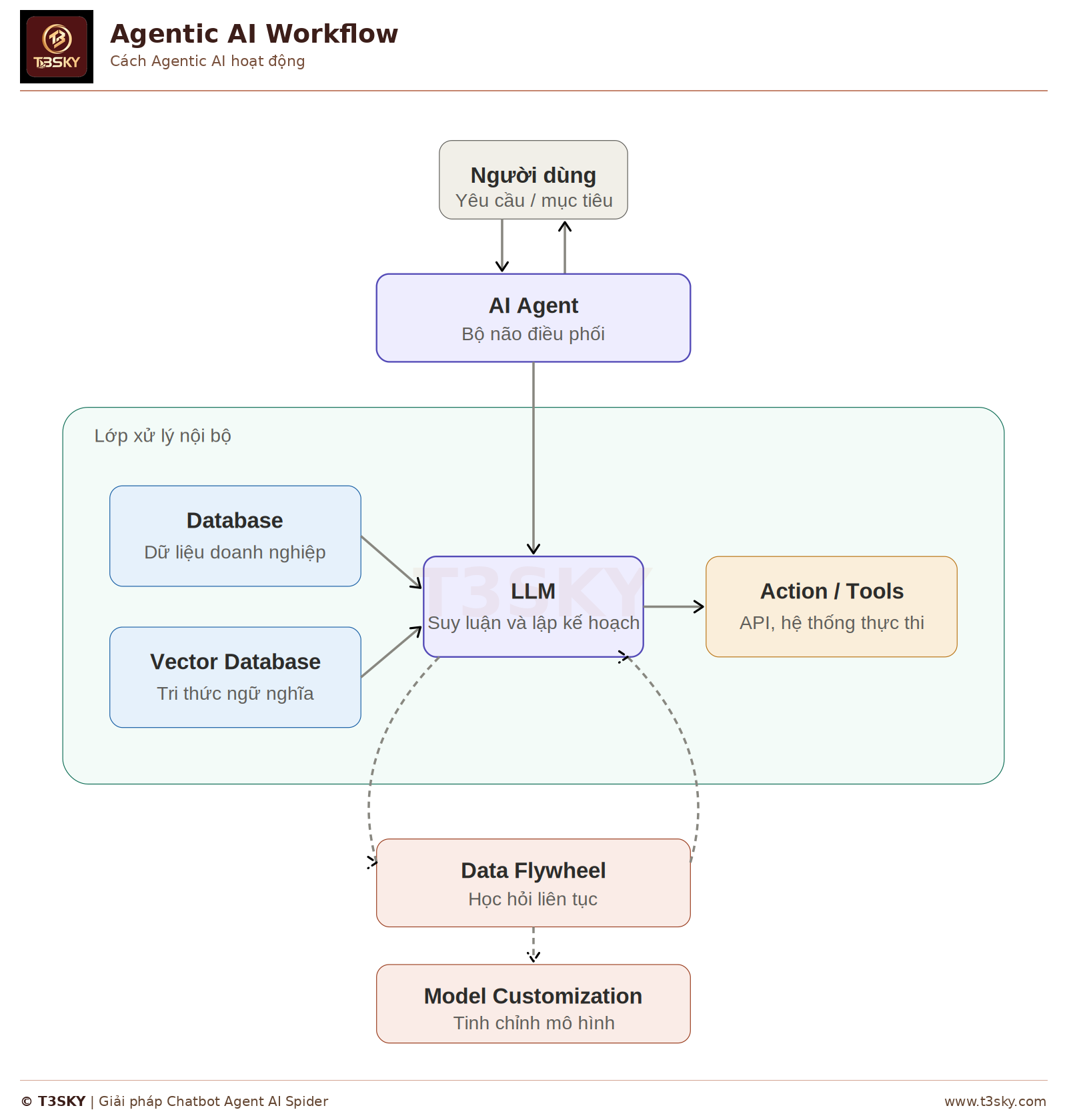
A typical agentic AI system runs through four continuous loops:
3.1. Perception
The agent takes in a request or a signal from its environment — a user request, an event in the system (a new order, a customer signing up) or a change in the data (raw material prices rising, stock running low).
3.2. Reasoning & planning
This is the agent’s "brain" — using an LLM to understand the goal, analyse the situation and break the large task into a sequence of small, executable steps. The agent also decides for itself which tools it needs and in what order.
3.3. Action
The agent calls tools or APIs to carry out each step: sending email, updating the CRM, querying a database, calling the switchboard, producing a report, making a payment… This is the core difference from generative AI — agentic AI does not only "say" but also "do".
3.4. Learning & reflection
After each action the agent observes the result, assesses whether the goal has been met and whether adjustment is needed. If it fails, it tries another way. The process repeats until the goal is achieved — or the agent determines that a human needs to step in.
Thanks to this loop, agentic AI gets smarter the more it is used, rather than reacting rigidly to a script.
4. Practical applications of agentic AI in business
This is the most important part. Let us look at where agentic AI is genuinely creating value in modern organisations.
4.1. Fully automated customer service
Unlike a traditional chatbot that only answers questions, agentic AI in customer service can:
- Analyse customer and order history.
- Check stock and delivery status in real time.
- Handle refund requests, exchanges and order updates automatically, without a member of staff.
- Propose personalised solutions based on customer behaviour.
- Hand over full context to a colleague when specialist handling is needed.
Real results: many businesses that have deployed it report a 50–70% reduction in the repetitive workload of the customer service team, alongside a marked rise in CSAT (customer satisfaction).
4.2. Sales and marketing automation
Agentic AI is reshaping how sales teams work:
- Lead qualification: automatically scoring and classifying leads based on behaviour, engagement and CRM data.
- Personalised email at scale: drafting and sending email by segment, following up automatically on an optimal schedule.
- Booking appointments: checking the sales rep’s calendar, proposing suitable times, sending the invitation and confirming.
- Competitor analysis: tracking competitors’ prices, promotions and product reviews and compiling weekly insight.
4.3. Finance and accounting
In finance, agentic AI can take on:
- Automatically reconciling invoices against purchase orders and delivery notes.
- Detecting unusual transactions and flagging risk for human review.
- Extracting data from contracts and invoices into the ERP system.
- Producing periodic financial reports and preparing management commentary.
4.4. Supply chain management
This is one of the areas where agentic AI creates the clearest value. The system can:
- Forecast demand based on consumption trends, weather and events.
- Reorder stock automatically when inventory hits a threshold.
- Reroute deliveries when something goes wrong (traffic, weather, industrial action).
- Allocate resources between warehouses in real time.
The result: less excess inventory, a higher on-time delivery rate and optimised operating costs.
4.5. Software development
Product development teams are applying agentic AI to:
- Read requirements, design the architecture, write code, test and deploy to a certain degree.
- Analyse bugs, propose fixes and open pull requests.
- Review code automatically against the company’s best practices.
- Monitor system performance and warn before an incident occurs.
4.6. Recruitment and HR
- Screening CVs automatically and matching skills against the job description.
- Scheduling interviews around the availability of the candidate and the panel.
- Sending invitation and rejection emails, following up and filing records in the ATS.
- Compiling feedback from each interview round to support the decision.
4.7. Healthcare
- Helping doctors analyse large volumes of patient data to suggest treatment.
- Writing clinical notes automatically, booking follow-up appointments and sending patient reminders.
- Monitoring patients remotely and raising an alert when something looks wrong.
5. The benefits agentic AI brings to a business
5.1. Productivity rises exponentially
When a single agent can take on a whole chain of work rather than just one step, the organisation’s overall productivity rises dramatically — not by 10–20% but potentially three or four times over in the right processes.
5.2. Lower operating costs
Automating administrative, repetitive tasks substantially reduces the staffing cost of work that adds little value, while allowing the business to scale without hiring proportionally.
5.3. Faster, better decisions
Agentic AI processes large volumes of data in real time, spots patterns people would struggle to see and makes well-founded recommendations — helping leadership decide faster in a volatile environment.
5.4. An outstanding customer experience
Instant responses 24/7, deep personalisation, problems resolved completely on first contact — these are what agentic AI delivers and traditional tools cannot.
5.5. Freeing people for strategic work
When the agent takes on the repetitive work, staff can concentrate on creative thinking, building relationships and making complex decisions — the work that genuinely needs a person.
6. The challenges of deploying agentic AI
Alongside the benefits, businesses need to weigh several risks and challenges:
- Governance and control: the more autonomous the agent, the higher the risk without suitable guardrails. You need clear boundaries on what it may do and clear points where human approval is required.
- Security and access: the agent has deep access to internal systems — permissions must be designed tightly and every action audited.
- Data quality: agentic AI is only as good as the data it can reach. A business with disorganised data will struggle to deploy it effectively.
- Managing expectations: not every process suits an agent. Choosing the right initial use case decides success or failure.
- Organisational culture: staff need training to work with the agent rather than seeing it as a threat.
7. Where should Vietnamese businesses start with agentic AI?
This is a workable roadmap for most organisations:
Step 1 — identify two or three high-value, low-risk use cases. Repetitive processes with clear rules and available data are a good starting point: customer service, lead screening, invoice reconciliation…
Step 2 — standardise the data and the process. An agent cannot fix a disorganised process. Before deploying, describe the current workflow clearly: inputs, outputs and the decision points.
Step 3 — choose the right platform and partner. You can build it yourself or work with providers who already have a platform and delivery experience in Vietnam.
Step 4 — run a controlled pilot. Start small with clear KPIs (handling time, success rate, cost saved), then scale up.
Step 5 — keep optimising and expanding. The more an agent is "trained" on real feedback, the smarter it becomes — this is a long-term process, not a one-off project.
8. Conclusion
Agentic AI is not a passing technology trend but the next great leap in how people work alongside artificial intelligence. If generative AI changed how we create content, agentic AI is changing how entire organisations operate — from customer service, sales and finance through to supply chain and product development.
Vietnamese businesses face a clear opportunity: whoever masters agentic AI early will hold a decisive competitive advantage in productivity, cost and customer experience over the next three to five years. But this is not a race to "buy the newest technology" — it is a race to "pick the right problem, standardise the process and deploy with control".
Start with one small use case, measure the result, learn and expand. That is the most durable way to turn agentic AI from an interesting concept into a genuine competitive advantage for your organisation.
